
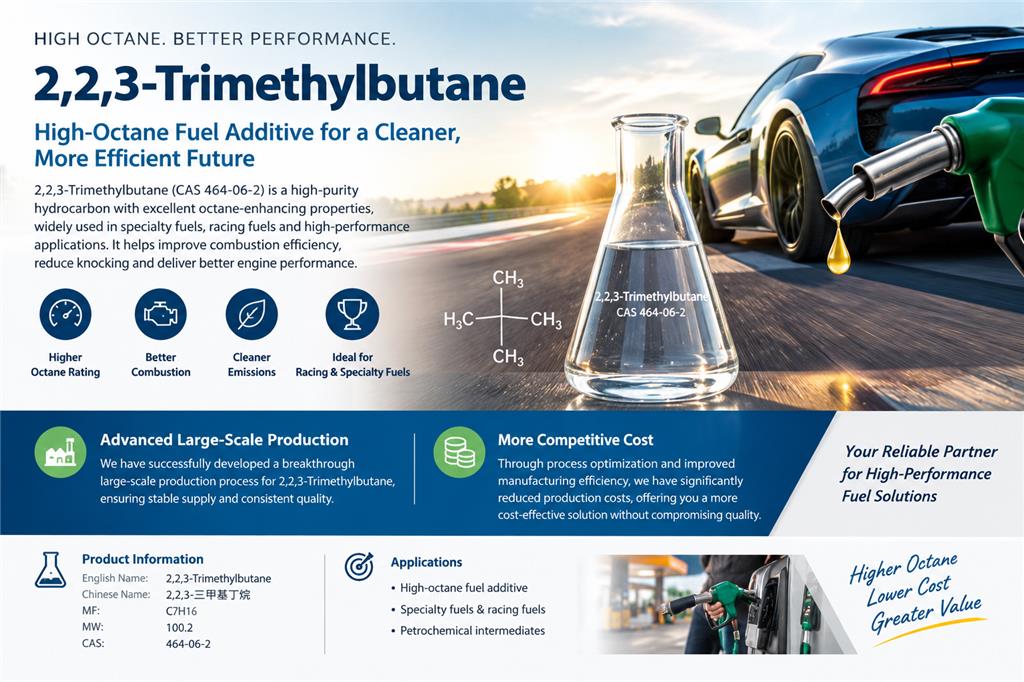
As the demand for high-performance fuels continues to grow, fuel formulators are increasingly looking for hydrocarbon components that can provide high octane performance while maintaining good blending characteristics and commercial viability.
2,2,3-Trimethylbutane (CAS 464-06-2) is attracting increasing attention as a high-octane hydrocarbon for specialty fuel and high-performance fuel applications.
With the successful development of a large-scale production process, we are now able to supply 2,2,3-Trimethylbutane with improved production efficiency and a significantly more competitive cost structure.
2,2,3-Trimethylbutane is a highly branched C7 hydrocarbon with the molecular formula C7H16 and a molecular weight of approximately 100.2 g/mol.
| Property | Information |
|---|---|
| Chemical Name | 2,2,3-Trimethylbutane |
| CAS Number | 464-06-2 |
| Molecular Formula | C7H16 |
| Molecular Weight | 100.2 g/mol |
| Chinese Name | 2,2,3-三甲基丁烷 |
Its highly branched molecular structure is closely associated with its excellent anti-knock characteristics, making it an interesting component for fuel formulations where octane performance is an important consideration.
Octane rating is a critical parameter in gasoline and specialty fuel formulation. Higher-octane fuels can provide greater resistance to engine knock, which is particularly important for high-compression-ratio and high-performance engines.
Highly branched hydrocarbons generally demonstrate favorable anti-knock behavior compared with less-branched hydrocarbons. For this reason, 2,2,3-Trimethylbutane can serve as a valuable high-octane hydrocarbon component in specialized fuel formulations.
Potential applications include:
High-octane gasoline formulations
Racing and motorsport fuels
Specialty performance fuels
Fuel-blending components
Research and development of advanced gasoline formulations
Other applications requiring high anti-knock hydrocarbon components
For racing fuel manufacturers and specialty fuel formulators, the combination of molecular structure, hydrocarbon purity and supply economics can be particularly important when developing a competitive formulation.
One of the major challenges associated with specialty hydrocarbons is not simply identifying a technically suitable compound, but developing a commercially viable manufacturing process.
For 2,2,3-Trimethylbutane, we have successfully overcome this challenge.
Through process development and optimization, we have established a large-scale production process for 2,2,3-Trimethylbutane (CAS 464-06-2).
The breakthrough in production technology enables us to move beyond small-scale or laboratory-oriented supply and provide a more commercially competitive solution for customers with larger requirements.
Our production development has focused on:
Improving production efficiency
Optimizing the manufacturing process
Increasing production scale
Improving cost efficiency
Supporting more stable commercial supply
Maintaining consistent product quality
As a result, we are able to offer a more competitive cost structure for customers evaluating 2,2,3-Trimethylbutane for commercial fuel applications.
For specialty fuel manufacturers, the technical performance of an ingredient is only one part of the equation. Cost is equally important when moving from laboratory development to commercial production.
A material that is technically suitable but expensive or difficult to produce at scale may have limited commercial value.
Our large-scale production breakthrough changes this equation for 2,2,3-Trimethylbutane.
By improving the production process and reducing manufacturing costs, we can provide a more economically attractive source for customers who are evaluating:
Higher-octane fuel formulations + larger production volumes + improved raw-material economics
This is particularly relevant for customers in the specialty fuel, racing fuel and performance gasoline sectors.
Racing and high-performance fuel formulations often require carefully selected hydrocarbon components to achieve specific fuel characteristics.
2,2,3-Trimethylbutane is of interest in this field because of its highly branched structure and high anti-knock potential.
Depending on the overall formulation and fuel specification, it can be considered as a component in:
Racing Fuels
High-performance engines can require fuels with specific octane characteristics. 2,2,3-Trimethylbutane can be evaluated as part of specialized racing fuel formulations.
Specialty Gasoline
Fuel manufacturers developing specialty gasoline products can evaluate highly branched hydrocarbons as part of their formulation strategy.
Fuel R&D
Research organizations and fuel companies can use 2,2,3-Trimethylbutane when studying the relationship between hydrocarbon structure, octane performance and combustion characteristics.
Our focus is not only on supplying a chemical product, but also on solving the commercial challenges associated with specialty fuel raw materials.
For customers considering 2,2,3-Trimethylbutane (CAS 464-06-2), we can discuss requirements including:
Required purity
Trial quantities
Commercial quantities
Packaging
Delivery destination
Fuel application
Long-term supply requirements
For larger-volume projects, our production capability allows us to evaluate the requirement based on a more scalable supply model.
If you are currently sourcing 2,2,3-Trimethylbutane (CAS 464-06-2) for high-octane fuel, racing fuel or specialty fuel applications, we would be pleased to discuss your requirements.
Our successful development of a large-scale production process allows us to provide a more competitive source of this specialty hydrocarbon while supporting larger-volume commercial projects.
Product: 2,2,3-Trimethylbutane
CAS: 464-06-2
Formula: C7H16
Molecular Weight: 100.2 g/mol
Contact us with your required quantity, specification and destination, and we can evaluate the most suitable supply solution for your project.
Higher Octane. Scalable Production. More Competitive Cost.